Measurement · 6 September 2026 · 8 min read
Heart rate variability, explained: the number we measure in clinic
Heart rate variability is the clearest window we have into how your nervous system is balancing stress and recovery. What it is, how it is measured, what a reading can and cannot tell you.
By Dr Arthur Kaganovitch (Chiropractor)
Updated 7 September 2026
Every heart has a rhythm, but a healthy heart does not beat like a metronome. The gap between one beat and the next is always shifting, by a fraction of a second, in a pattern that turns out to say a great deal about how your nervous system is coping. That shifting gap is heart rate variability, and it is the single measure we take in clinic most often, because it is the clearest window we have into the balance between stress and recovery.
What HRV actually is
Heart rate and heart rate variability sound alike but describe different things. Heart rate is simply how many times your heart beats per minute. HRV is the variation in the timing between those individual beats, measured in milliseconds. A heart beating at a steady 60 beats per minute could still have a wide range of HRV values, because two hearts averaging the same rate can vary that timing very differently from beat to beat.[3]
That variation is not noise or a flaw in the system. It reflects the ongoing tug of war between the two branches of the autonomic nervous system: the sympathetic branch, which speeds the heart up and prepares the body for action, and the parasympathetic branch, largely carried by the vagus nerve, which slows it down and supports rest and digestion. We cover that nerve in more detail in our vagus nerve explainer. HRV is essentially a readout of how actively those two systems are negotiating, moment to moment.
Why higher is generally better, but not always good
As a broad pattern, a higher HRV tends to reflect a nervous system with more capacity to adapt, recover and shift smoothly between effort and rest.[1] That is why HRV is widely used as a general marker of resilience and recovery, in clinical research and increasingly in consumer wearables.
It is not, however, a score where higher is unconditionally better in every context, and it is not a single number with one correct target for everyone. HRV is shaped by age, sex, genetics, fitness, and even the time of day and the position you are measured in, so a healthy value for one person can sit well outside a healthy range for another.[1] An unusually high reading can also appear alongside irregular heart rhythms or other conditions, which is why context and a trained eye matter more than the raw figure on its own. The number means little without knowing what is normal for that particular person.
Two ways of reading the same signal
HRV can be analysed in more than one way, and it helps to know the two broad approaches exist even without the mathematics behind them. Time-domain measures look directly at the pattern of intervals between beats over a stretch of time, calculating things like the overall spread of variation, and they are simple, intuitive and widely used. Frequency-domain measures instead break that same signal down into different speeds of oscillation, roughly separating faster, breath-linked variation from slower, longer-wave variation, which can offer a more detailed picture of the sympathetic and parasympathetic contributions underneath the headline number.[2] In practice, the two approaches are measuring the same underlying variability from different angles, and most clinical and consumer tools report a mix of both.
What else moves the number
Because HRV is so sensitive to the state of the nervous system, it is also sensitive to almost anything that state responds to. Your breathing rate at the moment of measurement has a direct effect, since breathing itself drives some of the natural variation between beats. Body position matters too, with readings typically differing between lying down, sitting and standing. Recent exercise, caffeine, illness, and simply how rested you are on the day can all shift a reading in one direction or another.[1] None of that makes the measurement unreliable. It is exactly why the original clinical standards for HRV specify a controlled way of taking it: a set duration, a consistent position, and quiet, settled breathing, so that the reading reflects the nervous system rather than the conditions around it.[2]
Why your own baseline matters more than a population average
Because HRV varies so much between individuals, a single resting reading is far more useful compared against that same person’s own history than against a generic population norm. A value that looks low on a chart of average adults might be entirely normal for one person and a genuine signal of strain for another. This is why, in clinic, a first reading serves mainly as a baseline. What matters from there is the trend for that individual: is their own number moving up or down over time, and how does it sit against their own typical range, not against a stranger’s average.
Dr Arthur Kaganovitch (Chiropractor), who founded Aura in Toorak, treats a first HRV reading the same way. It is a starting point, not a verdict. What he is looking for over a course of care is whether a person’s own baseline is shifting, because that shift is a more honest reflection of a nervous system moving out of protection than any single reading taken in isolation.
The trend matters more than the number.
How it is taken at Aura
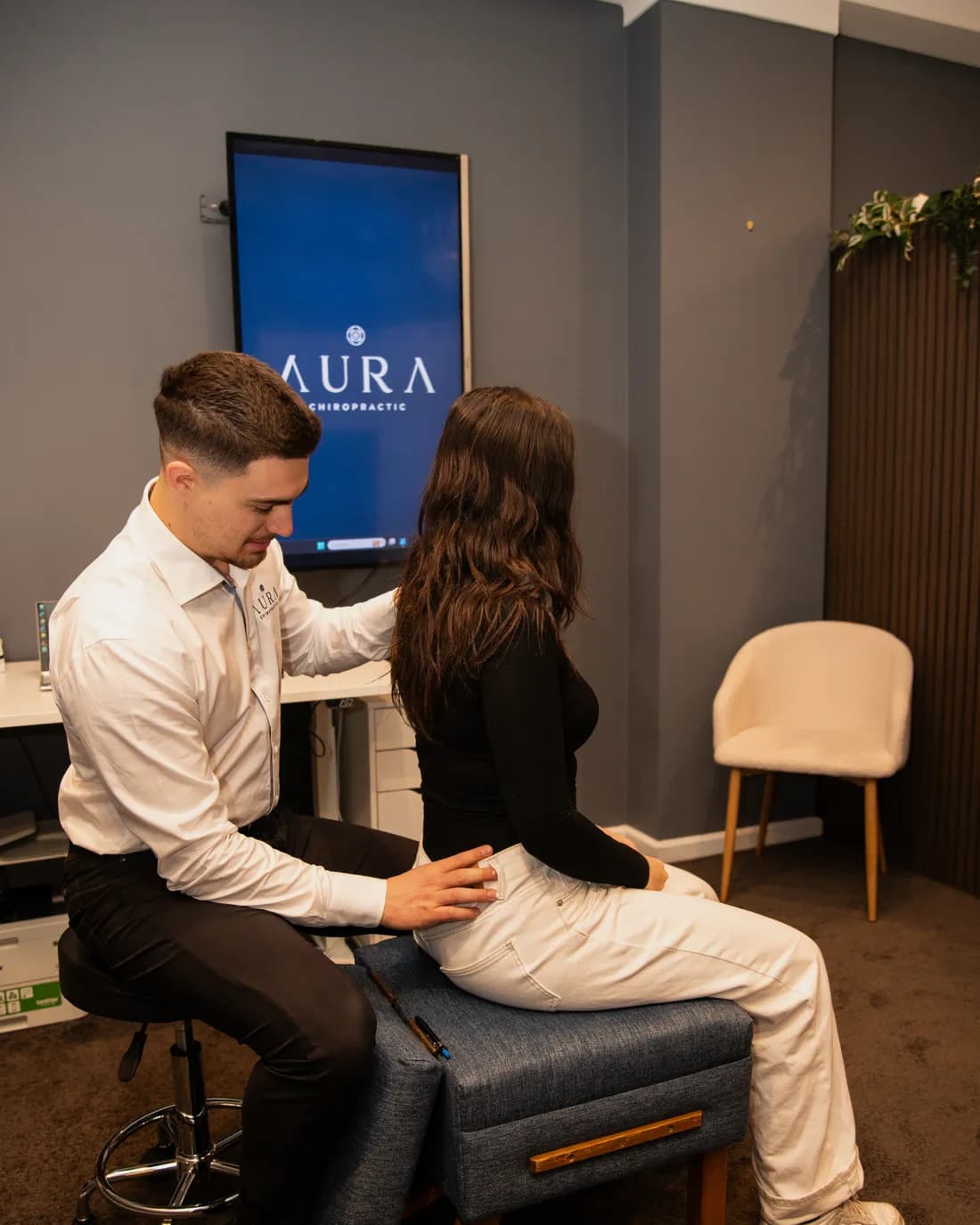
At Aura, HRV is taken as a short resting reading, as part of the broader nervous system assessment rather than as a standalone test. You sit quietly while a brief recording captures the natural variation in your heartbeat, alongside the other measures used to build a picture of how your nervous system is functioning, which we set out in full on our nervous system page. The reading is explained to you in plain language, not handed over as a raw number, and it becomes part of the baseline we track as care continues.
If you are curious what your own reading would show, the way to find out is a proper assessment. Aura’s first visit includes a $99 Initial Assessment, ordinarily $189, for new patients, one per person, with no obligation to continue.
Sources
- 1. Shaffer F, Ginsberg JP. An Overview of Heart Rate Variability Metrics and Norms, 2017. View source
- 2. Task Force of the European Society of Cardiology and the North American Society of Pacing and Electrophysiology. Heart rate variability: standards of measurement, physiological interpretation, and clinical use, 1996. View source
- 3. Shaffer F, McCraty R, Zerr CL. A healthy heart is not a metronome: an integrative review of the heart's anatomy and heart rate variability, 2014. View source
This article is general information, not a diagnosis or a substitute for individual care. The population figures and guideline positions above are drawn from the cited sources. Observations attributed to Dr Arthur Kaganovitch (Chiropractor) reflect his clinical experience at Aura and are not claims of guaranteed outcomes.
Read more about how the nervous system drives symptoms and about the Aura Nervous System Reset.

Dr Arthur Kaganovitch (Chiropractor), Founder, Aura Chiropractic
I founded Aura Chiropractic with a clear purpose: to raise the standard of chiropractic and health care in Melbourne. My interest is the autonomic nervous system and how your own genetics shape the way your body carries stress.
About Dr Arthur