The nervous system · 6 September 2026 · 7 min read
The vagus nerve, explained without the hype
The vagus nerve has become a wellness buzzword. Here is what it actually does, what it does not do, why it matters for a body stuck in protection, and what the research supports.
By Dr Arthur Kaganovitch (Chiropractor)
Updated 7 September 2026
The vagus nerve has had a strange decade. It has gone from a term most people only heard in a physiology lecture to something sold alongside cold plunges and breathing gadgets, promising to switch off stress at the push of a button. Some of what is said about it is grounded in real physiology. A good deal of it is stretched well past what the evidence supports. This is an attempt to separate the two, plainly.
What the vagus nerve actually is
The vagus nerve is the tenth cranial nerve, and it is the main cable of the parasympathetic nervous system, the branch that governs rest, digestion and recovery rather than alarm. It leaves the base of the skull and travels down through the neck and chest into the abdomen, touching an unusually wide territory along the way: the heart, where it helps set your resting heart rate, the lungs, where it influences breathing rate, and the gut, where it coordinates digestion and communicates constantly with the trillions of microbes living there.[1] Its name comes from the Latin for wandering, which is a fair description of how far it reaches.
Roughly four out of every five fibres in the vagus nerve are not carrying instructions from the brain down to the organs. They are carrying information the other way, from the gut and heart and lungs back up to the brain.[1] That detail matters more than it sounds. The vagus nerve is less a remote control the brain uses on the body, and more a constant stream of reporting that shapes how the brain perceives the state of the body, and by extension, how safe or threatened it feels.
Why it also matters for the gut and inflammation
One reason the vagus nerve keeps turning up in wellness conversations is a genuine and interesting finding: it does not only carry signals about heart rate and breathing, it also plays a part in how the body regulates inflammation. Researchers have described a pathway in which vagal activity helps dampen inflammatory signalling in the body, and there is a growing body of work linking vagus nerve function to gut health, mood and inflammatory conditions.[1] This is part of why the nerve is sometimes called the communication highway between the gut and the brain, a description that is broadly fair.
Where this tips into overreach is when a single mechanism gets stretched into a cure-all. A pathway that plausibly links the vagus nerve to inflammation is not the same thing as evidence that any particular gadget, supplement or breathing app resolves a specific gut condition or mood disorder in a given person. The underlying biology is real and worth understanding. What it can deliver for any one person, and how reliably, is a much narrower and still developing question.
What “vagal tone” means
Vagal tone is the term for how active and responsive that parasympathetic influence is. Someone with strong vagal tone tends to settle quickly after a stressful moment, their heart rate and breathing coming back down without much delay. Someone with low vagal tone tends to stay activated for longer after the same event, as though the system is slower to receive the message that the threat has passed.
You cannot see vagal tone directly, and there is no simple dial that reads it out. What clinicians and researchers use instead is an indirect marker: heart rate variability, or HRV, the small natural variation in the time between one heartbeat and the next. The reasoning is straightforward. The vagus nerve is one of the main influences on that beat-to-beat timing, so a heart that varies its rhythm more, within a healthy range, is generally read as a heart under stronger parasympathetic influence.[2] It is a genuinely useful proxy, not a perfect window. We go into how it is measured and what it does and does not show in our HRV explainer.
What the “stimulate your vagus” claims can and cannot deliver
Cold water on the face, slow exhale-led breathing, humming, gargling: all of these are said online to “stimulate the vagus nerve” and switch the body into calm almost instantly. There is a kernel of truth in this. Slow, extended exhalation genuinely does engage parasympathetic pathways that involve the vagus nerve, which is why a long breath out can measurably settle heart rate in the moment. That is real, and it is one reason we point patients toward practices like the physiological sigh, a pattern with genuine research behind it.
Where the marketing overreaches is scale and permanence. The formally studied form of vagus nerve stimulation is a surgically implanted device, used clinically for drug-resistant epilepsy and treatment-resistant depression, delivering a controlled electrical pulse directly to the nerve.[4] That is a different order of intervention entirely from a cold splash of water or a humming exercise. A breathing pattern or a cold shower can nudge your state in the moment, and that nudge is worth having. It is not evidence that the same practice permanently raises your baseline vagal tone, repairs a dysregulated nervous system, or substitutes for addressing why the system became dysregulated in the first place. The honest version is that these tools help you influence a moment, not that they fix the pattern underneath it.
Where it sits in a body stuck in protection
Dr Arthur Kaganovitch (Chiropractor), who founded Aura in Toorak, thinks about the vagus nerve as one instrument in a larger orchestra rather than the whole performance. What he sees most often in clinic is a nervous system that has been sitting in a protective state for a long time, under sustained stress, poor sleep and a body that has stopped moving through its full range. In that picture, low vagal tone is not the cause of the problem. It is a downstream sign of it, one more piece of evidence that the system has been leaning toward protection rather than recovery.
That is why a single breathing technique rarely resolves someone who has been stuck in that pattern for months or years. It can take the edge off in the moment, which has real value, but the underlying question is what has kept the system oriented toward threat for so long, and what it would take to give it a consistent, repeated signal that it is safe to stand down. That is the work an assessment at Aura is built to identify, starting with an honest reading of where your own nervous system actually sits, not a generic protocol borrowed from a video.
A calmer nervous system is built by repetition, not by a single breath.
If you want to understand how we look at the nervous system as a whole, rather than one nerve in isolation, that is set out on our nervous system page. The first step for anyone curious what their own system is doing is a proper first visit.
Sources
- 1. Breit S, Kupferberg A, Rogler G, Hasler G. Vagus Nerve as Modulator of the Brain-Gut Axis in Psychiatric and Inflammatory Disorders, 2018. View source
- 2. Shaffer F, Ginsberg JP. An Overview of Heart Rate Variability Metrics and Norms, 2017. View source
- 3. Task Force of the European Society of Cardiology and the North American Society of Pacing and Electrophysiology. Heart rate variability: standards of measurement, physiological interpretation, and clinical use, 1996. View source
- 4. Howland RH. Vagus Nerve Stimulation, 2014. View source
This article is general information, not a diagnosis or a substitute for individual care. The population figures and guideline positions above are drawn from the cited sources. Observations attributed to Dr Arthur Kaganovitch (Chiropractor) reflect his clinical experience at Aura and are not claims of guaranteed outcomes.
Read more about how the nervous system drives symptoms and about the Aura Nervous System Reset.
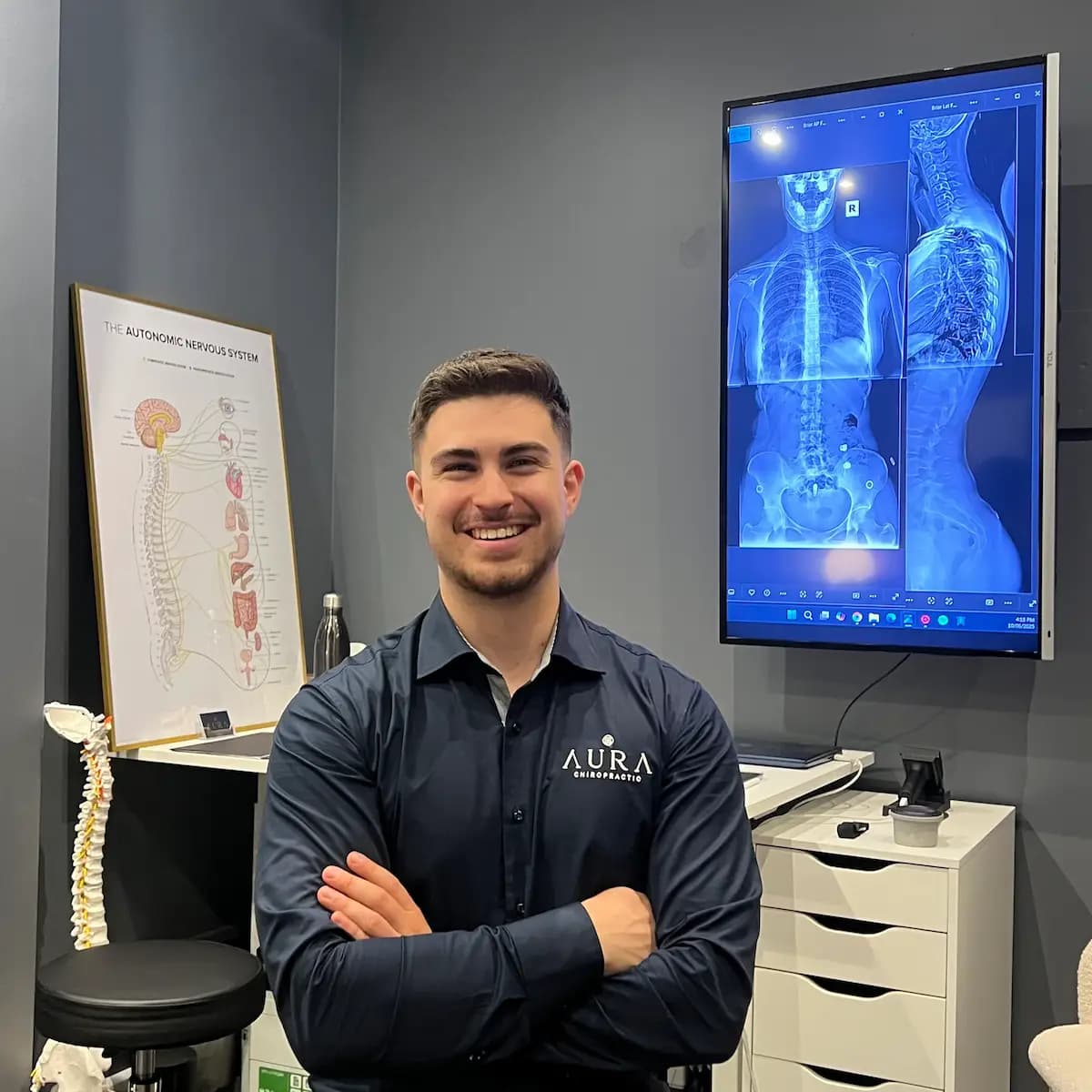
Dr Arthur Kaganovitch (Chiropractor), Founder, Aura Chiropractic
I founded Aura Chiropractic with a clear purpose: to raise the standard of chiropractic and health care in Melbourne. My interest is the autonomic nervous system and how your own genetics shape the way your body carries stress.
About Dr Arthur