Full body assessment and examination
How your frame carries daily load, then segment by segment along the spine to find exactly where it is bracing.
Finds the weak and dysfunctional areas that need attention.
The nervous system
Neck pain, headaches, sciatica, brain fog, a body that will not switch off. Often these are one overloaded system showing up in different places. We measure it first, then care for it. Nervous system chiropractic in Toorak, Melbourne.
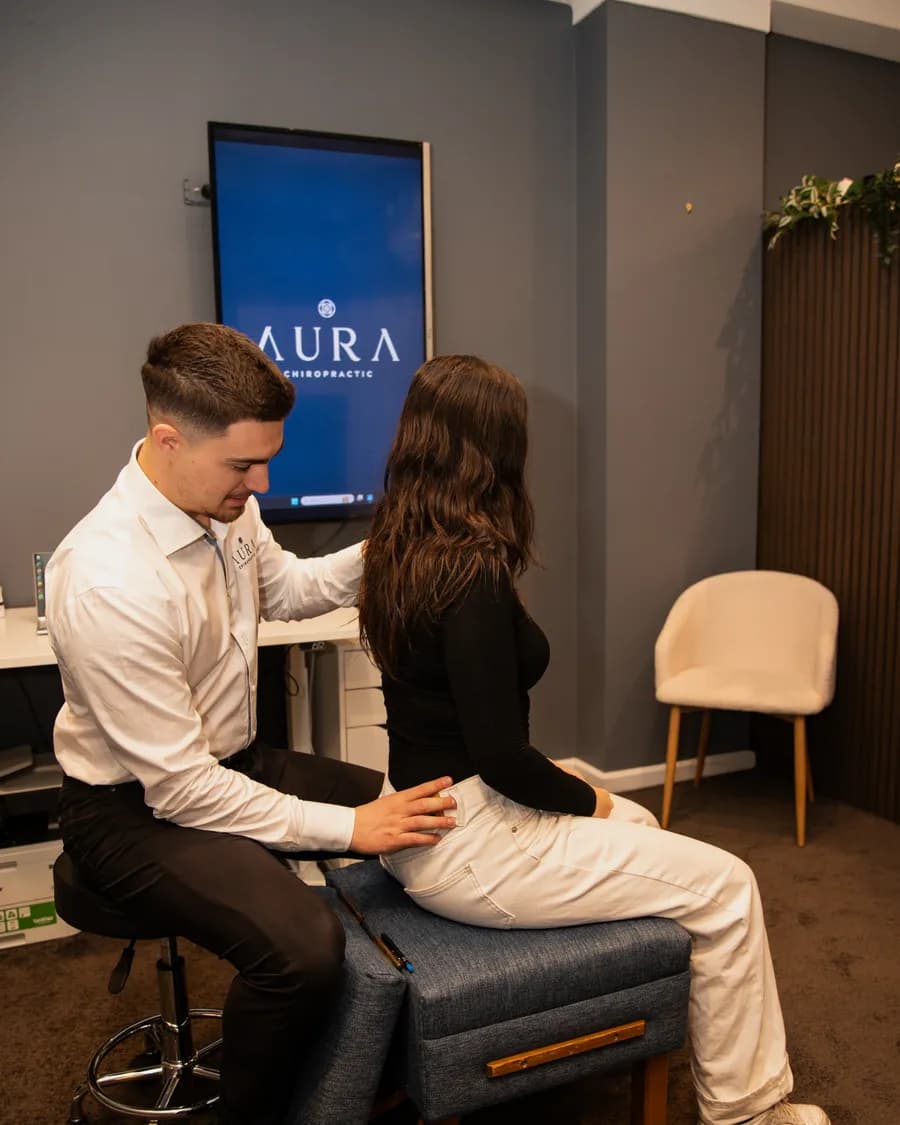
Your nervous system has two settings that share the controls: protection, the fight or flight response, and recovery, where you digest, repair and sleep. A healthy system moves between them many times a day and settles back into recovery once the pressure passes. Stuck in protection means it stops coming back down, so the body stays braced long after the pressure that caused it has gone.
Protection is run by the sympathetic branch: heart rate up, muscles braced, digestion paused, attention narrowed to the threat. Recovery is run by the parasympathetic branch and the vagus nerve: heart rate down, muscles soft, digestion and repair back on, sleep possible. Both are normal, and both are meant to take turns.
Short bursts of stress are useful. The trouble starts when the pressure never quite passes. The World Health Organization notes that stress which goes on for a long time can affect both physical and mental health.[1] In plain words, the body stays braced for a threat that is now a mortgage, a deadline and a phone that never stops. This is what Dr Arthur Kaganovitch (Chiropractor) calls being stuck in protection. The wiring is doing its job. It has simply forgotten how to stand down.
A braced body is a stiff body. When the protective setting stays on, the muscles along the spine hold their guard, the joints they cross lose their normal movement, and the nerves passing through those segments become irritated. That is the same overloaded system arriving as a stiff neck, a headache that climbs from the base of the skull, a lower back that grabs when you stand, or sciatic pain down one leg.
It does not stop at the spine. Digestion runs on the recovery setting, so gut trouble sits in the same picture. So does brain fog, because a system on alert spends its budget on scanning rather than thinking. So does the body that cannot switch off at night. One in five Australians aged 45 and over live with chronic pain,[2] and back problems are among the most common long-term conditions in the country,[3] reported by 15.7% of Australians, Australian Bureau of Statistics, 2022.[5] In Dr Arthur’s experience, the sore spot is usually the loudest part of a wider pattern, and the pattern is what gets missed when every visit starts and ends with the sore spot.
Heart rate variability is the small, natural variation in the gap between one heartbeat and the next, read at rest. It reflects how the stress side and the recovery side of your nervous system are balancing at that moment. Psychological stress is associated with reduced heart rate variability,[6] which is why we take it as an objective reading rather than relying on how a hard week feels.
A rolling scanner reads skin temperature down both sides of your spine. Skin temperature is governed by the same nerves that run the protective setting, so an uneven pattern points to the segments where your nervous system is working hardest. It is a map of where to look rather than a diagnosis, and it is read alongside the examination findings rather than on its own.
Regulation is the state your nervous system is in: how readily it moves out of protection and back into recovery. The adjustment is the specific, by-hand correction made to one spinal segment. The first is what we are trying to change, the second is one of the levers we use to change it. Regulation comes before adjustment. We measure the state first, then decide what, if anything, to adjust.
Yes. Children carry the same wiring with far less practice using it, and at Aura they are examined with the same measures as adults, adapted to their age. Dr Arthur Kaganovitch (Chiropractor) is trained in paediatric care, the techniques are gentle and specific to a small frame, and a parent stays with their child for the whole visit. Many families come in together, because a household under load tends to share it.
When a child’s system is stuck in protection it rarely announces itself as pain. It looks like meltdowns over small things, sleep that is hard to reach and easy to lose, tummy aches with nothing obvious behind them, a child who cannot sit still or cannot get going. Whether care is suitable is decided after the examination, and we will tell you plainly if it is not.
| Measure | What it shows | How often |
|---|---|---|
| Spinal examination | Where your frame is bracing, segment by segment | At the $99 Initial Assessment |
| Heart rate variability | How your system is balancing stress and recovery at rest | At the Initial Assessment, then monthly inside the 12 week program |
| Thermographic scans | Skin temperature patterns along the spine, showing where the system is working hardest | At the Initial Assessment, then monthly inside the 12 week program |
| Neurological examination | Reflexes, balance, coordination and nerve function, tested by hand | At the $99 Initial Assessment |
What we measure
Each one is repeated over time, so your progress is measured against your own baseline.
How your frame carries daily load, then segment by segment along the spine to find exactly where it is bracing.
Finds the weak and dysfunctional areas that need attention.
A short reading of the gap between your heartbeats, taken at rest. It shows how your nervous system is balancing stress and recovery right now, not how you feel about it.
The gold standard of nervous system health measurement.

A rolling scanner reads skin temperature along your spine. Uneven patterns point to where the nervous system is working hardest.
Measures irritation and inflammation in the spine and nervous system.

Reflexes, balance, coordination and nerve function, tested by hand. It tells us how well your brain and body are communicating.
Gives us an insight into where your body needs extra help.
The conditions it drives
The same pattern, arriving in different places. Each page explains what we look for and what the first visit involves.
The adjustment
The Gonstead adjustment is a specific, by-hand correction to one spinal segment that has lost its normal position or movement. Restoring movement to a guarded segment changes the signal travelling between that part of the spine and the brain. In Dr Arthur’s view, that is the lever: give the system a reason to stand down, and then measure whether it has.
It is chosen rather than routine: one segment, because the examination, the thermographic scan and the spinal analysis all point to it. It is gentle, and nothing else is moved. Nothing is done without a reason we can show you.
Heart rate variability, the thermographic scan and the neurological examination are repeated over the course of care, and each reading is compared with your own first visit rather than with a textbook average.[4]
Your first visit is the $99 Initial Assessment, ordinarily $189, for new patients only. It includes all four measures and a full history. You then return for a Report of Findings, where Dr Arthur walks you through your readings, shows you what they mean, and sets out what care would involve if it is suitable. There is no obligation to continue.
Read more
Short articles by Dr Arthur on the ideas behind this page.
 The nervous system
 MeasurementMeasurement
 The nervous system
 The nervous system
 Sleep
Sleep Practical
 PracticalThe method
This page is general information, not a diagnosis or a substitute for individual care. The population figures and guideline positions above are drawn from the cited sources. Observations attributed to Dr Arthur Kaganovitch (Chiropractor) reflect his clinical experience at Aura and are not claims of guaranteed outcomes.
Chiropractic care that starts by measuring how your nervous system is regulating, rather than only where it hurts. At Aura that means heart rate variability, thermographic scans, a neurological examination and a full spinal examination before anything is adjusted. The Gonstead adjustment is then directed by those findings, and the same measures are repeated over time against your own baseline.
Heart rate variability is the small, natural variation in the gap between one heartbeat and the next. It is read at rest and reflects how the two sides of the autonomic nervous system, the stress side and the recovery side, are balancing at that moment. It is a snapshot of regulation, not a diagnosis, and we read it alongside the other findings rather than on its own.
Yes. Dr Arthur Kaganovitch (Chiropractor) is trained in paediatric care, and children and families are a large part of the practice. The assessment is adapted to the child's age, uses gentle and specific techniques, and a parent is with them for the whole visit. Whether care is suitable is decided after the examination, and we will tell you plainly if it is not.
No. You can book directly online or by phone on (03) 9661 0447. Your first visit is the $99 Initial Assessment, ordinarily $189, for new patients only, one per person, with no obligation to continue.
Written by Dr Arthur Kaganovitch (Chiropractor). Last reviewed 8 September 2026.

The nervous system quiz
Two minutes. Sixteen quick taps. Find out which of four patterns your body is running on.
Take the quiz
One visit to measure it. $99, ordinarily $189, new patients only, no obligation to continue.