We treat
Whiplash treatment in Toorak
A neck that stiffens up in the days after an impact is a body protecting itself. Our work is to find what it is guarding, and help it stop needing to.

How it tends to show up
Does this sound like you?
01
Neck stiffness or pain that arrived hours or days after the accident, not at the time
02
Headaches that start at the base of the skull and have only appeared since the impact
03
Trouble turning your head far enough to check a blind spot or reverse the car
04
Aching between the shoulder blades, or pain, tingling or heaviness spreading into an arm
05
Feeling foggy, wound up or unusually tired since the accident, alongside the neck pain
What whiplash actually is
Whiplash is what happens when the head is thrown rapidly in one direction and then back again, faster than the neck can control. The joints, discs, ligaments and muscles of the neck are loaded well beyond the range they normally work in, and the small muscles that hold the head steady are asked to catch a load they were never built to catch.
It is not only a high speed crash. A low speed rear end bump in traffic, a fall, a tackle on a sporting field or a hard landing can all produce it. The size of the dent in the car is a poor guide to what happened to the neck inside it.
Why it often shows up a day or two later
Most people walk away from the moment feeling shaken but not especially sore. Adrenaline is doing exactly what it is designed to do, which is to keep you functioning through an emergency and hide the damage until the emergency is over. Over the following twelve to seventy two hours the swelling builds and the muscles around the injured joints tighten into a protective splint, and that is usually when the stiffness, the headache and the restricted turn appear.
This delay is normal, and it is also the reason people talk themselves out of getting checked. The moment you feel fine is not the moment you have the most information about your neck.
The nervous system picture
Dr Arthur Kaganovitch (Chiropractor) sees whiplash as a nervous system event as much as a tissue one. The upper neck is one of the most densely wired parts of the body for position sense: it constantly reports where your head is in space, and the brain uses that report alongside your eyes and inner ear to keep you balanced and oriented. When those joints are injured and then held rigid by guarding, that report becomes noisy.
That is often the missing explanation for the symptoms people find hardest to describe after an accident: the fog, the unsteadiness, the short fuse, the sleep that will not settle. They are not separate problems that happened to arrive the same week. They tend to travel with a neck that is bracing and a system that has not come back down out of alarm.
Care is directed at both parts. Restoring movement to the joints that have locked down, and settling a nervous system that is still behaving as though the impact has not finished.
When whiplash needs medical assessment first
Some symptoms after an impact need a hospital or your doctor before anything else. Go straight to an emergency department for a loss of consciousness at the time of the accident, severe or worsening headache, repeated vomiting, numbness or weakness in both arms or both legs, difficulty swallowing or speaking, or severe midline neck pain and tenderness after a significant impact.
These are uncommon, and they are the reason the assessment starts with a full history of the accident itself before anything is examined.
What we do
Your assessment starts with the accident: what hit what, from which direction, where your head was looking, what you felt at the time and what has changed since. That history shapes the examination far more than the label whiplash does.
From there it is a full spinal and neurological examination, posture analysis, and Gonstead analysis of the neck to find which specific joints have lost their normal movement rather than treating the whole area as one sore block. We measure heart rate variability and run thermographic scans, which is how we see whether the system is still sitting in alarm, and we refer for spinal imaging if what we find clinically indicates it.
Then we explain what we found in plain language before any care begins.
What we do
Measure first, then care for the cause
Most care treats the symptom. We measure the nervous system driving it, explain it plainly, then care for what we found.

Stage one: Book an initial consultation
One visit, $99, ordinarily $189. A full history and examination so we understand what your body has been carrying and for how long.

Stage two: Neurological scans and Report of Findings
Dr Arthur Kaganovitch (Chiropractor) explains all the different scans and results and comes up with a bespoke, unique plan for your needs.
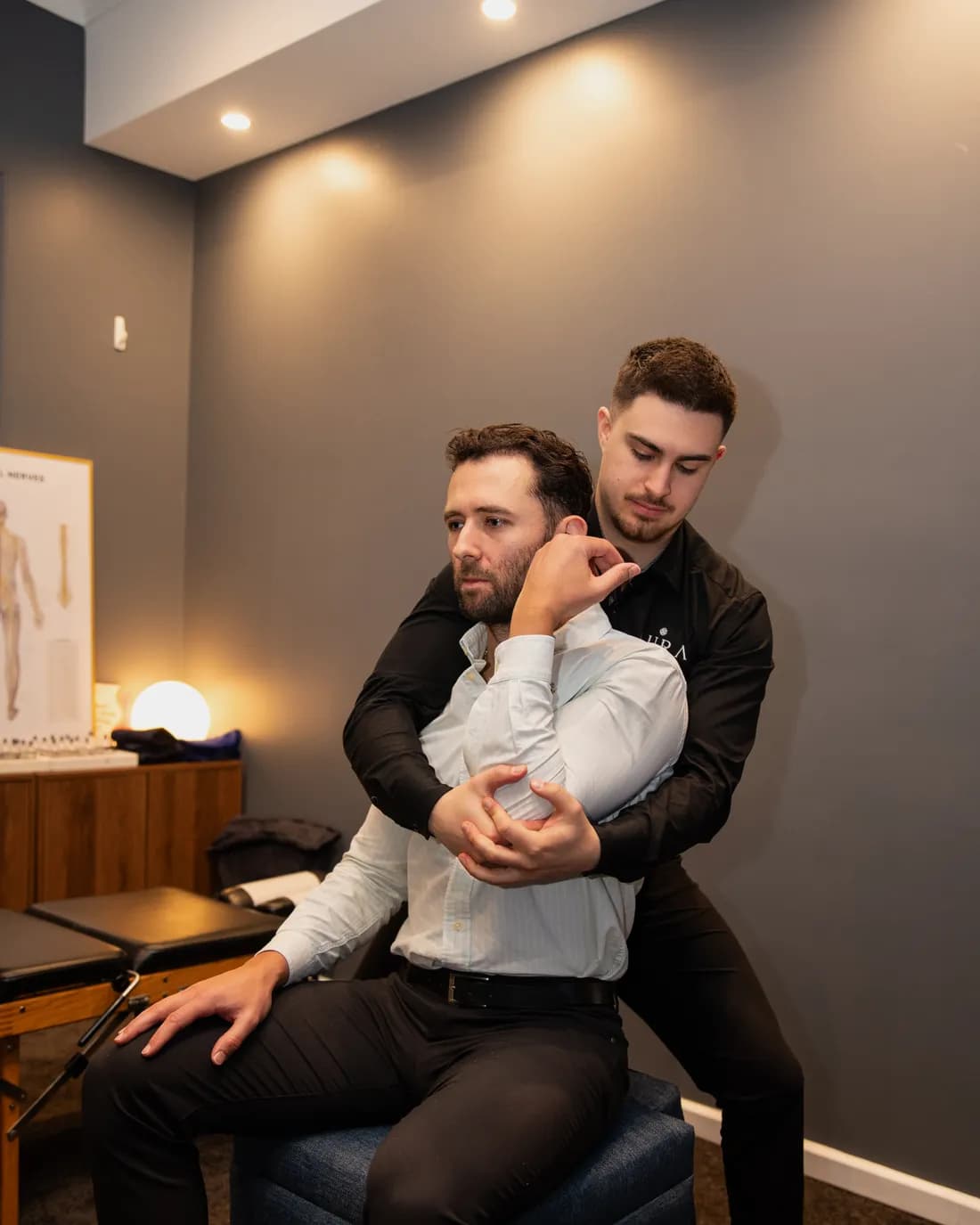
Stage three: Nervous system first chiropractic care
Specific, gentle adjustments directed at what the scans and examination found, re-measured against your own baseline so you can see what has shifted.
Your first visit
What the $99 assessment includes
$99, ordinarily $189. New patients only, one per person, no obligation to continue.
- Full case history
- Spinal examination
- Posture analysis
- Neurological examination
- Heart rate variability (HRV) measurement
- Thermographic (skin-temperature) scans
- Referral for spinal imaging (X-ray) if clinically indicated
Any imaging is charged by the imaging provider, not by Aura, and is not included in the $99.
Once anything urgent has been ruled out, sooner is better than later, and you do not need to wait for the pain to become unbearable. Being examined while the picture is still fresh means we can track how it changes rather than guessing backwards from a neck that has been guarding for months.
A clear scan rules out fracture and serious structural damage, which is exactly what it is for. It does not measure how a joint is moving, how hard the surrounding muscles are working to protect it, or how the nervous system is responding. Those are examination findings, not imaging findings, and they are what we assess.
Headaches that begin at the base of the skull and refer up over the head are a common pattern after a neck injury, because the upper neck and the nerves that supply the back of the head share the same neighbourhood. Whether that is what is driving yours is something the examination works out rather than assumes.
No. A neck that has been guarding for months is a different presentation from one injured last week, and it is worth understanding what has settled and what has quietly become the new normal. We assess what is there now rather than what should have happened by now.
The first visit is $99, ordinarily $189. It is for new patients only, one per person, as a one-off payment, with no obligation to continue. Any imaging is charged by the imaging provider and is not included in the $99.
No. Chiropractic is a primary contact profession in Australia, so you can book directly, with no referral needed.
Observations attributed to Dr Arthur Kaganovitch (Chiropractor) reflect his clinical experience at Aura and are not claims of guaranteed outcomes. This page is general information, not a diagnosis or individual advice.
Related
Keep reading
The professional

Neck pain

Headaches and migraines

Disc bulge and injury
The Gonstead method, explained: analysis before adjustment
From the journal
Why we analyse before we adjust. The five steps of the Gonstead system, what the instrument and the X-ray are for, and why specificity is the whole point.
Fight, flight and freeze: the three responses, and what freeze looks like
From the journal
Most people know fight and flight. Fewer recognise freeze, which is often what a burnt-out professional or an overwhelmed child is actually in. The three responses explained, and how we measure them.
Written by Dr Arthur Kaganovitch (Chiropractor). Last reviewed 8 September 2026.

Your body has been stuck in protection long enough
One visit to measure it. $99, ordinarily $189, no obligation to continue.