We treat
Pinched nerve treatment in Toorak
Burning, tingling or weakness down an arm or a leg usually means a nerve is being irritated somewhere it should not be. The work is finding where.
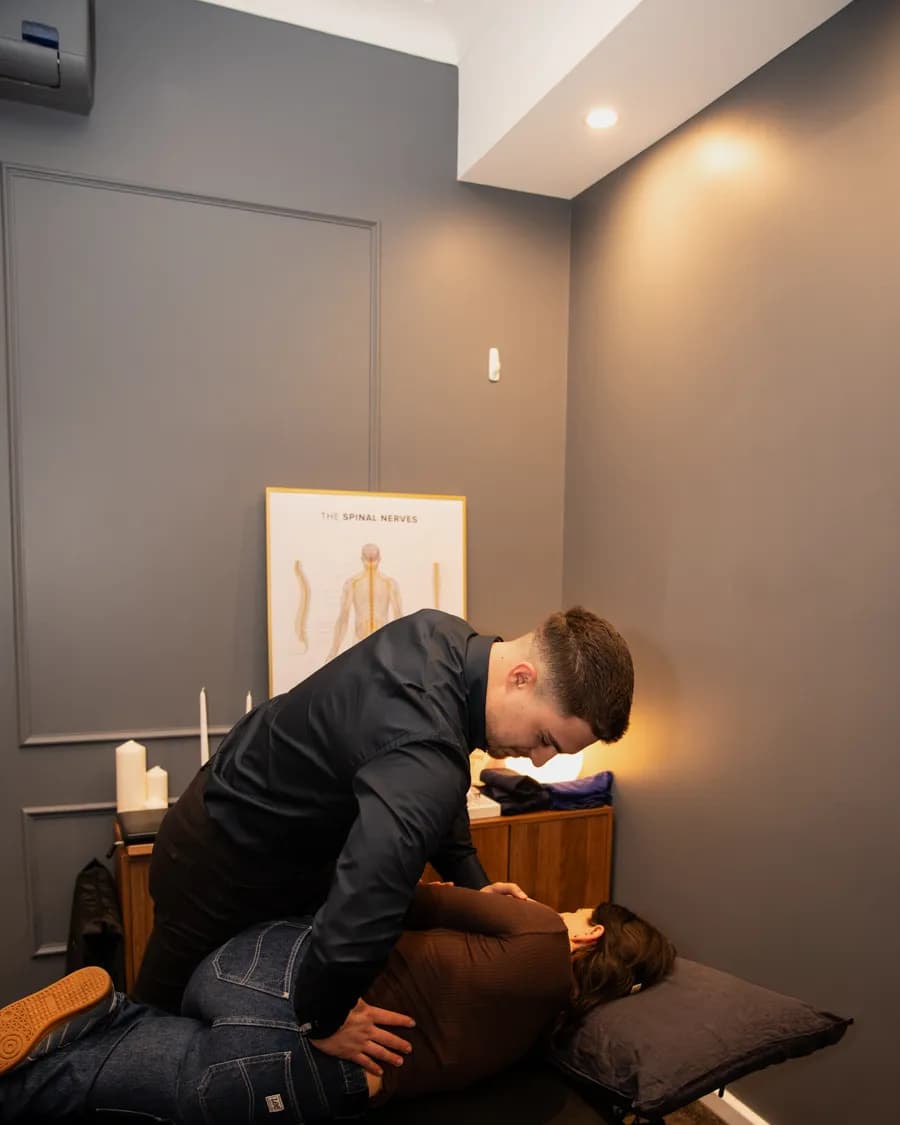
How it tends to show up
Does this sound like you?
01
Pins and needles, burning or numbness travelling down an arm or a leg
02
A sharp, electric pain that fires with one particular movement or position
03
Weakness in a hand or a foot, dropping things or catching a toe on the ground
04
Pain that is worse at night, or that wakes you when you roll over
05
Neck or back pain that has changed character and now travels rather than staying put
What a pinched nerve is, and where it happens
Pinched nerve is everyday language for a nerve that is being compressed or irritated along its path. Most often that happens where the nerve leaves the spine, through a small opening between two vertebrae, and anything that narrows that space or inflames its contents can set the nerve complaining. A disc that has bulged, a joint that has lost its normal movement, swelling around either, or a combination of all three.
Where you feel it depends on which nerve. Nerves leaving the neck supply the shoulder, arm and hand, so an irritated nerve root there produces symptoms down the arm. Nerves leaving the lower back travel down the leg, which is what most people mean by sciatica. A nerve can also be compressed further along its route rather than at the spine, at the elbow or the wrist for example, which produces a different pattern again.
Why the pain is felt away from the problem
This is the part that confuses people most. The hand tingles, so it feels obvious that the problem is in the hand. But a nerve reports symptoms along everything it supplies, not at the point where it is being squeezed, so the loudest symptom is often the furthest from the source.
It is also why treating the sore area alone rarely holds. Rubbing a calf that is aching because of an irritated nerve root in the lower back is working on the messenger. National guidance on low back pain and sciatica takes the same view: identify what is actually driving the nerve symptoms, and be cautious about treating on the basis of where it hurts.[1]
What a scan can and cannot tell you
Imaging is useful, and it has real limits. A large review of scans taken from people with no pain at all found disc bulges and degenerative changes in a substantial proportion of them, and the proportion climbed steadily with age.[2] In other words, a scan finding is common and does not by itself prove that finding is what is causing your symptoms.
That is why we read imaging alongside the examination rather than instead of it. What matters is whether the level the scan flags is the level your examination is actually pointing to, and whether the pattern of your symptoms matches the nerve that would be involved.
When a pinched nerve is urgent
A small number of nerve presentations are medical emergencies. Go to an emergency department immediately for loss of bladder or bowel control, numbness in the saddle area between the legs, or weakness in both legs that is getting worse. These can indicate compression of the nerve bundle at the base of the spine, which needs surgical assessment urgently rather than any form of manual care.
Progressive weakness in a single limb, or numbness that is steadily spreading, also needs medical assessment first. We screen for all of this in the neurological examination before anything else happens.
What we do
Your assessment includes a full case history, a spinal examination and a neurological examination that tests reflexes, muscle strength and sensation, which is how we work out which nerve is actually involved rather than guessing from the map of where it hurts.
Dr Arthur Kaganovitch (Chiropractor) uses Gonstead analysis to find the specific level that has lost its normal movement, since a general area is not enough to work with when the target is one nerve root. We measure heart rate variability and run thermographic scans, which can show asymmetry in how the nervous system is regulating either side of the spine, and we refer for spinal imaging if what we find clinically indicates it.
You get the findings explained plainly before any care begins.
What we do
Measure first, then care for the cause
Most care treats the symptom. We measure the nervous system driving it, explain it plainly, then care for what we found.

Stage one: Book an initial consultation
One visit, $99, ordinarily $189. A full history and examination so we understand what your body has been carrying and for how long.
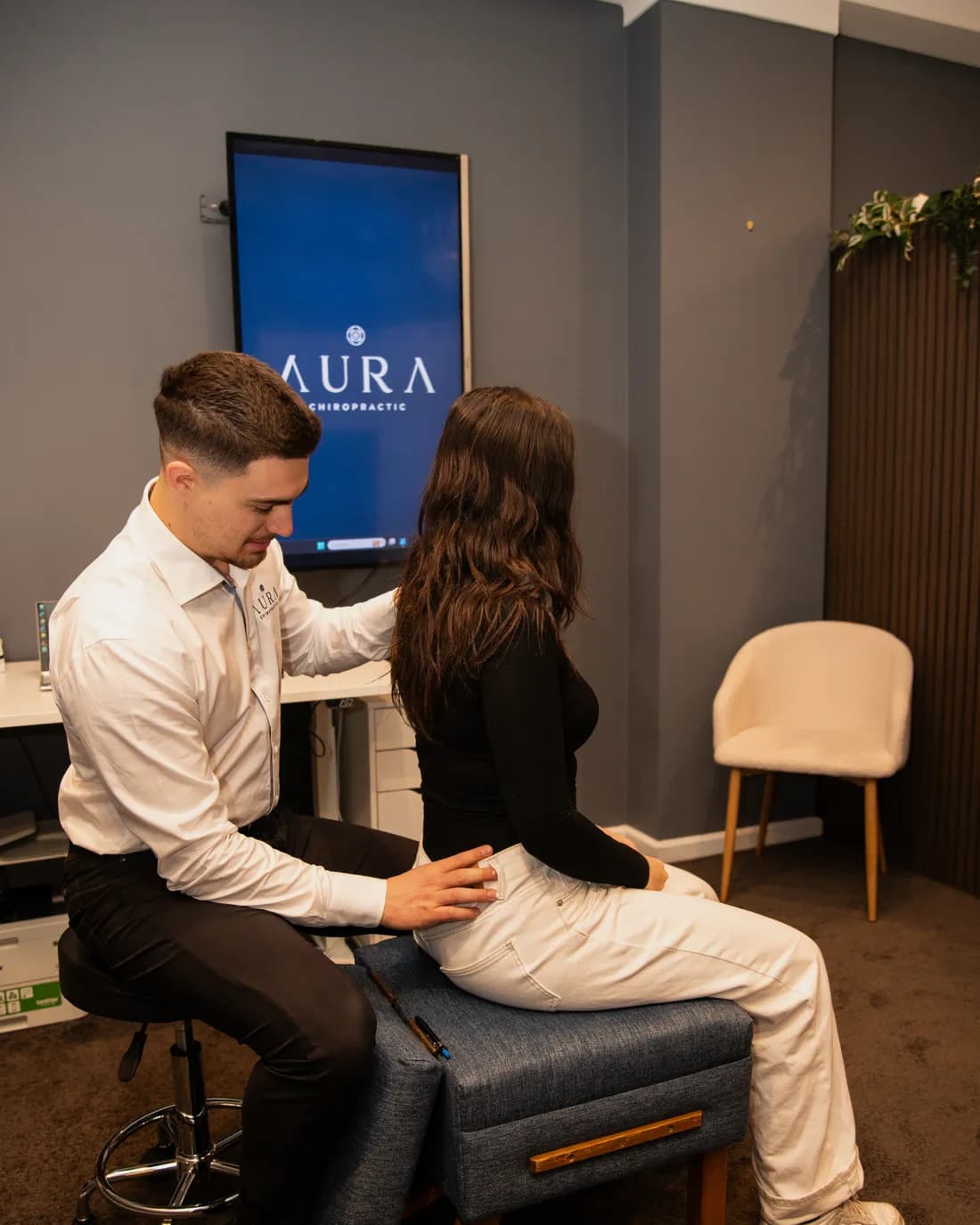
Stage two: Neurological scans and Report of Findings
Dr Arthur Kaganovitch (Chiropractor) explains all the different scans and results and comes up with a bespoke, unique plan for your needs.
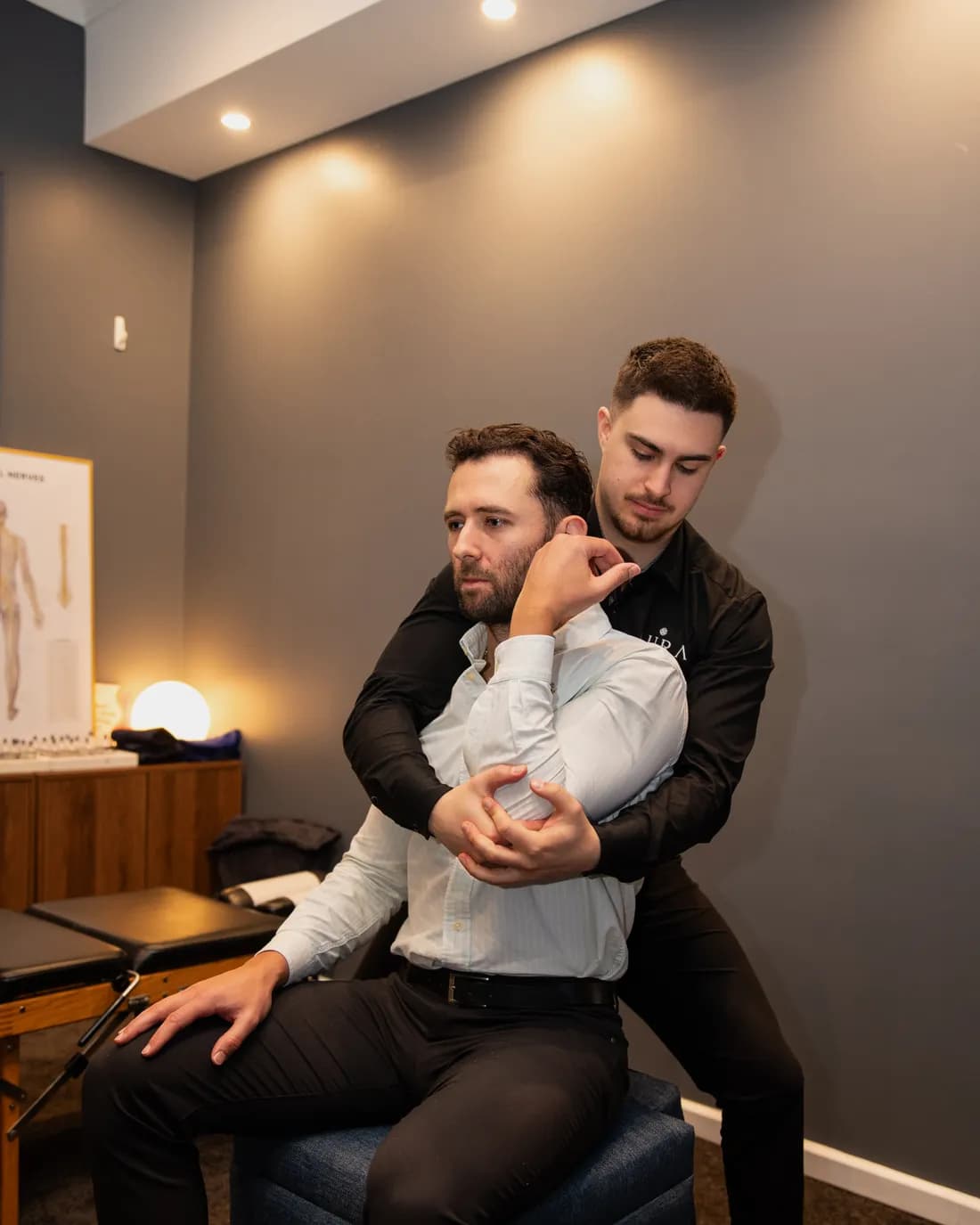
Stage three: Nervous system first chiropractic care
Specific, gentle adjustments directed at what the scans and examination found, re-measured against your own baseline so you can see what has shifted.
Your first visit
What the $99 assessment includes
$99, ordinarily $189. New patients only, one per person, no obligation to continue.
- Full case history
- Spinal examination
- Posture analysis
- Neurological examination
- Heart rate variability (HRV) measurement
- Thermographic (skin-temperature) scans
- Referral for spinal imaging (X-ray) if clinically indicated
Any imaging is charged by the imaging provider, not by Aura, and is not included in the $99.
Sciatica is one kind of pinched nerve, specifically irritation of a nerve root in the lower back producing symptoms down the leg. A nerve can also be irritated in the neck and produce symptoms down the arm, or be compressed further along its path. The examination is what tells us which one you have.
Many nerve irritations do settle over weeks as the inflammation reduces, and many do not, particularly where the movement problem that produced the irritation is still there. What we can tell you after an examination is which pattern yours looks like and whether anything about it needs urgent attention.
No. Imaging is ordered when the clinical picture calls for it, not routinely, because scan findings are common in people without symptoms and can send care in the wrong direction. If your examination indicates imaging, we will refer you for it, and any imaging is charged by the imaging provider rather than by Aura.
That is what the neurological examination is for, and it comes before anything else. Most nerve presentations respond well to restoring movement at the level involved. A small number need surgical assessment first, and the examination is what separates them.
The first visit is $99, ordinarily $189. It is for new patients only, one per person, as a one-off payment, with no obligation to continue. Any imaging is charged by the imaging provider and is not included in the $99.
No. Chiropractic is a primary contact profession in Australia, so you can book directly, with no referral needed.
Sources
- 1. National Institute for Health and Care Excellence (NICE). Low back pain and sciatica in over 16s: assessment and management (NG59), 2016, updated 2020. View source
- 2. American Journal of Neuroradiology (AJNR). Systematic literature review of imaging features of spinal degeneration in asymptomatic populations, 2015. View source
Population figures and guideline positions are drawn from the cited sources. Observations attributed to Dr Arthur Kaganovitch (Chiropractor) reflect his clinical experience at Aura and are not claims of guaranteed outcomes. This page is general information, not a diagnosis or individual advice.
Related
Keep reading
The professional

Sciatica

Disc bulge and injury
Neck pain
Understanding lower back pain, and what actually helps it settle
From the journal
Lower back pain is the most disabling condition of working age, yet the vast majority of it is not what people fear. A researched, plainly written look at how common it really is, what tends to cause it, the part your nervous system plays, what the evidence says helps, and the myths worth retiring.
The Gonstead method, explained: analysis before adjustment
From the journal
Why we analyse before we adjust. The five steps of the Gonstead system, what the instrument and the X-ray are for, and why specificity is the whole point.
Written by Dr Arthur Kaganovitch (Chiropractor). Last reviewed 8 September 2026.

Your body has been stuck in protection long enough
One visit to measure it. $99, ordinarily $189, no obligation to continue.