The spine · 17 July 2026 · 9 min read
Understanding lower back pain, and what actually helps it settle
Lower back pain is the most disabling condition of working age, yet the vast majority of it is not what people fear. A researched, plainly written look at how common it really is, what tends to cause it, the part your nervous system plays, what the evidence says helps, and the myths worth retiring.
By Dr Arthur Kaganovitch (Chiropractor)
Updated 7 September 2026
If your lower back has been aching, seized up, or quietly wearing on you, the first thing worth knowing is that you are in very ordinary company. Back problems affect around 4.0 million Australians, roughly 16 per cent of the population, and they are the leading cause of disease burden for people aged 35 to 54, the busiest working and parenting years of life.[1] The second thing worth knowing is more reassuring: for the great majority of people, this is not the frightening thing they quietly suspect it might be.
How common it really is
Lower back pain is not a personal failing or a sign that your body has worn out early. It is close to a universal human experience. Globally it is the single leading cause of years lived with disability, and in 2020 an estimated 619 million people were living with it, a 60 per cent rise since 1990, with cases projected to reach 843 million by 2050 as populations grow and age.[2] Australia carries more than its share. Australasia has one of the highest rates of low back pain in the world, ranking third-highest globally in the most recent Global Burden of Disease estimates.[3]
Closer to home, back problems were the third leading cause of total disease burden in Australia and account for a meaningful slice of the nation’s health spending, an estimated 3.4 billion dollars in 2020 to 2021.[1] None of this is meant to alarm you. It is meant to make the point that if your back is troubling you, you are not an outlier, and the path back to comfortable movement is well trodden.
Most lower back pain is not what people fear
When the back hurts, the mind tends to reach for the worst explanation: a crumbling spine, a serious disc problem, damage that will only get worse. The evidence tells a calmer story. The vast majority of lower back pain is what clinicians call non-specific or primary, meaning it is genuine and often quite painful, but it is not caused by an underlying disease or structural emergency. The World Health Organization notes that chronic primary low back pain is commonly estimated to represent at least 90 per cent of chronic cases seen in primary care.[2] Serious pathology, the kind that needs urgent attention, is the rare exception rather than the rule.
That distinction matters, because how you understand your pain shapes how your body responds to it. A back that is sore but fundamentally sound calls for a very different approach from a back in danger, and most backs are the former.
What tends to be behind it
Non-specific does not mean random. It usually means the pain is coming from the ordinary working parts of the back, the joints, discs, muscles and ligaments, rather than from disease. Common contributors include:
- Spinal joints that have lost some of their normal movement, so the area no longer shares load the way it should.
- A disc under sustained load, which can irritate nearby tissue and the nerves that pass close by.
- Muscles that have tightened and started to guard, holding the area braced long after the original strain.
- Long hours seated, repetitive lifting, or postures held for so long that the back stops moving through its full range.
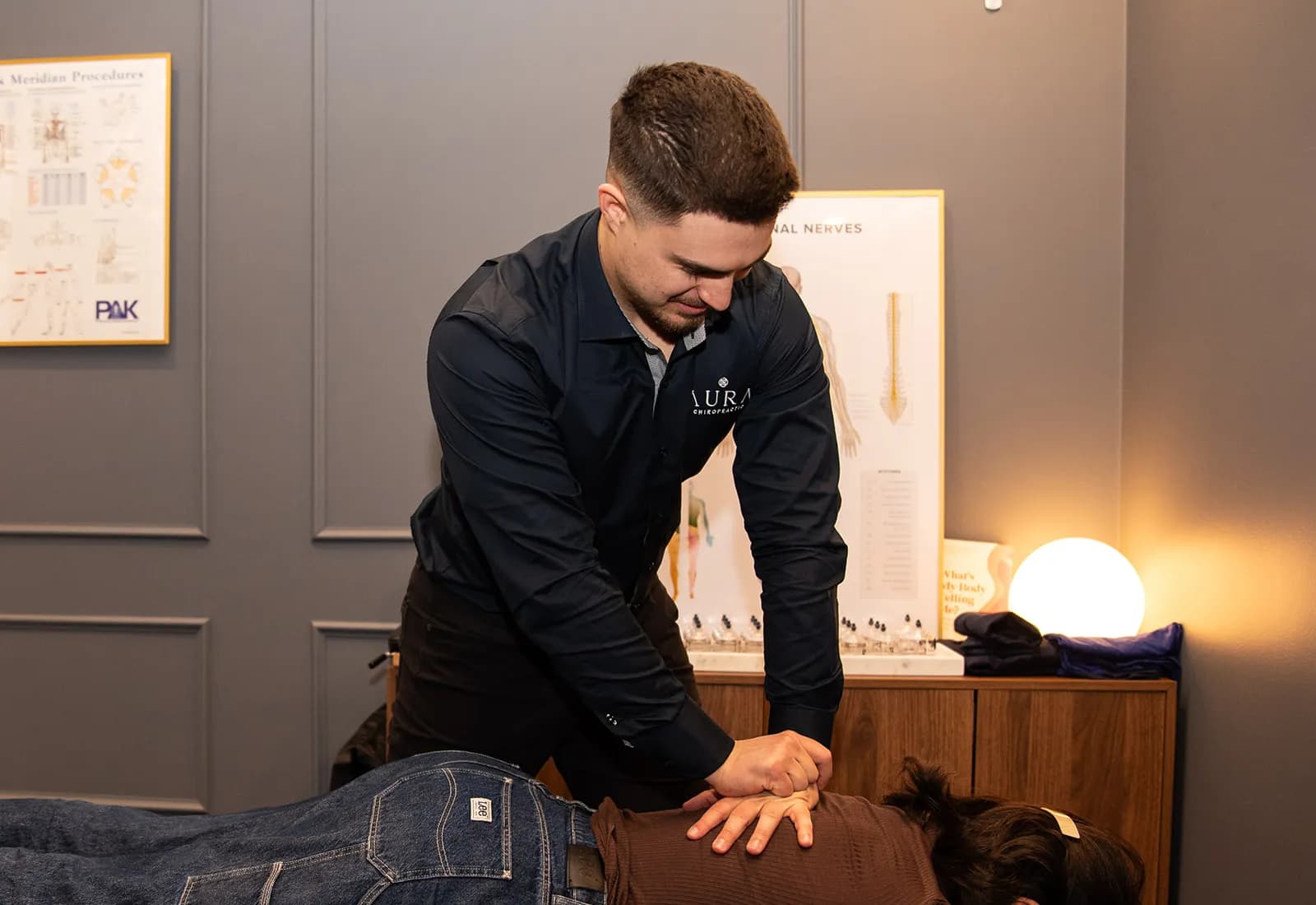
More often than not it is several of these at once, feeding into each other, which is why a single tidy label rarely captures the whole picture. Dr Arthur Kaganovitch (Chiropractor), who founded Aura in Toorak, describes his first job with any back as sorting out which of these is actually driving it. In his clinic he works through a short set of questions before anything else: is this a sitting problem, a load problem, a capacity problem, a joint irritation, or a muscle problem. The honest answer is often more than one, and naming them is what makes the plan specific rather than generic.
The part most people miss: your nervous system
Pain is produced and regulated by the nervous system. In the short term that is protective and useful. It asks you to move differently, to rest a little, to be careful while tissue settles. The difficulty begins when the system stays switched on after the original strain has healed. It keeps the muscles guarding, keeps you braced, and keeps the pain present. At that point the back is not so much injured as it is stuck in a protective pattern.
This is where Aura’s approach diverges from simply chasing the sore spot. What Dr Arthur finds most often is that people arriving with a stubborn low back are sitting in what he calls the protection phase of their nervous system, having been under sustained stress for a long time. It is rarely the back alone. It tends to be an accumulation, poor sleep, long hours, posture, diet, a life spent looking after everyone else, and the back is simply where the body has chosen to speak up. That is why, in his experience, low back pain so seldom travels alone, and why headaches and neck tension often arrive with it.
Calming an over-protective system, then, is not a soft add-on. It is the ground the rest of the work stands on. It is the difference between quietening a signal for an hour and giving the body a reason to stop sending it.
Regulation comes before adjustment.
What the evidence says helps
The good news is that the most effective first-line measures are also the least dramatic. Modern guidelines consistently point the same way. The WHO’s 2023 guideline on chronic low back pain recommends education and self-care, exercise programs, some physical therapies such as spinal manipulative therapy and massage, psychological therapies such as cognitive behavioural therapy, and anti-inflammatory medicines, and it stresses that a mix of these usually works better than any single treatment used on its own.[2] The UK’s NICE guideline takes the same balanced view of hands-on care: manual therapy, including spinal manipulation, is worth considering, but as part of a package that also includes exercise, rather than as a standalone cure.[4] That is an honest picture, and it is the one Aura works within: chiropractic care as one considered part of a broader plan, not a magic click.
It is just as useful to know what the evidence advises against. The WHO guideline identifies 14 interventions it does not recommend for most people, including lumbar braces and supports, traction, and opioid painkillers, judging that their likely harms outweigh their benefits.[5] If a proposed solution for ordinary back pain is a brace to wear or a strong opioid to take, that is worth a second question.
About scans and X-rays
Many people assume the first step is a scan to find the cause. For most lower back pain, the guidelines say the opposite. NICE advises against routinely offering imaging such as X-ray or MRI for low back pain outside specialist settings, reserving it for when the result would genuinely change what is done.[4] The reason is practical: scans of pain-free backs very often show bulges, wear and age-related change, so a scan can easily point the finger at something that was never the problem, and leave a person more worried, not less.
This is not a small issue in Australia, where back problems already account for a striking 8.7 per cent of all medical imaging expenditure.[1] Imaging has a real place when there is a clinical reason for it. The point is simply that a careful examination comes first, and a scan follows only when it is genuinely indicated. That is exactly how an assessment at Aura is structured.
What you can do yourself
The most evidence-backed piece of self-management is also the most counter-intuitive when you are sore: keep moving. NICE advises people to continue with their normal activities as far as they reasonably can, and staying active is now understood to help the back recover rather than harm it.[4] Prolonged bed rest, once standard advice, is no longer recommended.
Alongside the evidence, Dr Arthur offers the same handful of practical steps to patients most weeks. These are his clinical advice from years on the floor, not formal guideline recommendations, and they are the small things that tend to make the early days easier:
- Reach for an ice pack over a heat pack for a flared-up back.
- Sleep on your side with a pillow between your knees, to keep the lower back neutral overnight.
- Ease off repeated twisting movements while things are settling.
- Take relative rest rather than total rest. Gentle movement and walking are genuinely good for it; it is the aggravating loads you pull back from, not activity altogether.
- Notice what reliably sets the pain off, and reduce those triggers where you can.
Myths worth retiring
A few beliefs about backs have long outlived the evidence. Rest it until it settles is the biggest: the guidance now favours staying active over lying low.[4] A scan will find the cause is another: for ordinary back pain, imaging is usually not indicated and can mislead.[4] And pain always means damage quietly drives a lot of unnecessary fear, when in truth a back can hurt considerably while remaining fundamentally sound, and most does.[2]
When to have it looked at
Most lower back pain eases with time and sensible movement. It is worth having assessed when it is not settling after a couple of weeks, when it keeps returning, or when it is disturbing your sleep.
If your pain travels below the knee, or comes with numbness, pins and needles or weakness in the leg, the sciatic nerve may be involved, and you can read more on our sciatica page. If you would like to understand how we assess and help a stubborn low back in person, that is set out on our lower back pain treatment page, and the first step for anyone is always a proper first visit.
Sources
- 1. Australian Institute of Health and Welfare (AIHW). Back problems, 2024. View source
- 2. World Health Organization. WHO releases guidelines on chronic low back pain, 2023. View source
- 3. GBD 2021 Low Back Pain Collaborators, The Lancet Rheumatology. Global, regional, and national burden of low back pain, 1990 to 2020, with projections to 2050, 2023. View source
- 4. National Institute for Health and Care Excellence (NICE). Low back pain and sciatica in over 16s: assessment and management (NG59), 2016, updated 2020. View source
- 5. World Health Organization. WHO guideline for non-surgical management of chronic primary low back pain in adults, 2023. View source
This article is general information, not a diagnosis or a substitute for individual care. The population figures and guideline positions above are drawn from the cited sources. Observations attributed to Dr Arthur Kaganovitch (Chiropractor) reflect his clinical experience at Aura and are not claims of guaranteed outcomes.
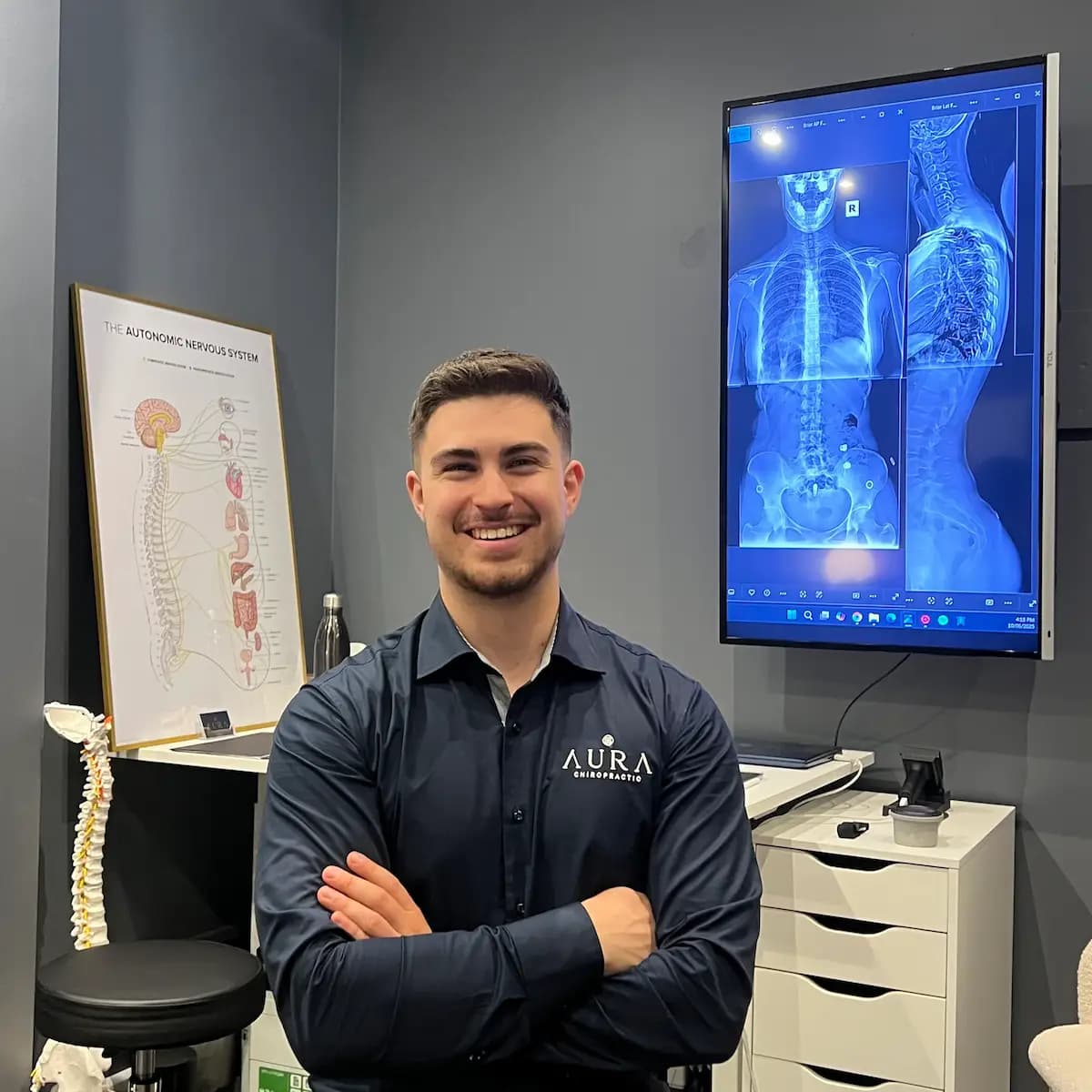
Dr Arthur Kaganovitch (Chiropractor), Founder, Aura Chiropractic
I founded Aura Chiropractic with a clear purpose: to raise the standard of chiropractic and health care in Melbourne. My interest is the autonomic nervous system and how your own genetics shape the way your body carries stress.
About Dr Arthur