Care during
Chiropractic care during pregnancy
A body carrying a pregnancy changes shape, weight and ligament tension over months. Care here is about comfort and movement while that happens.

How it tends to show up
Does this sound like you?
01
Low back or pelvic ache that has built as the pregnancy has progressed
02
A grinding or sharp pain at the front of the pelvis when walking or rolling over
03
Pain deep in one buttock, sometimes travelling into the back of the thigh
04
Rib and mid back discomfort in the later months as space runs short
05
Difficulty getting comfortable in bed, or pain turning over during the night
What actually changes
Three things happen at once, and they compound. The weight at the front of the body increases steadily, which shifts the centre of gravity forward and asks the lower back to work harder to keep you upright. Hormonal changes soften the ligaments through the pelvis in preparation for birth, which is necessary and useful and also means the pelvic joints are less stable than they were. And the ribcage and abdomen change shape as space is needed, which alters how you breathe.
So the discomfort many women report through the second and third trimesters is not a sign that something has gone wrong. It is a body doing something demanding. That does not mean it has to be endured without help.
Pelvic girdle pain, and why it is worth naming
The sharp, grinding pain at the front of the pelvis, or the deep ache in one or both sides at the back, is common enough to have its own name: pelvic girdle pain. It typically hurts most with the movements that load one leg at a time, so walking, stairs, getting out of a car and rolling over in bed are the usual culprits.
It is worth naming because women are frequently told it is simply part of being pregnant and left with nothing. It is common, and it is also something that can often be made more manageable with care directed at how the pelvis is moving, alongside practical changes to how you move through the day.
How care is adapted
Nothing about care during pregnancy looks like care for anyone else. Positioning changes: from the second trimester onwards, lying face down is managed with specific pregnancy support, and side lying is used where it is more comfortable. Technique changes: adjustments are lighter and more specific, and Dr Arthur Kaganovitch (Chiropractor) uses Gonstead analysis to work out exactly which joint needs attention rather than applying force through a pelvis whose ligaments are already softened.
The aim is stated plainly. Comfort, movement and function through a demanding few months. We do not make claims about the birth itself, the position of the baby, or the length of labour, and you should be cautious of anyone who does.
When to contact your maternity team
Contact your maternity care provider or go to hospital immediately for vaginal bleeding, fluid loss, severe or persistent abdominal pain, severe headache with visual changes or swelling, reduced movements from the baby, or contractions before term. None of these are chiropractic presentations and none of them should wait for an appointment here.
What we do
Your assessment includes a full case history covering the pregnancy to date and your maternity care, a spinal examination, posture analysis and a neurological examination, adapted to what is comfortable at your stage.
We measure heart rate variability and run thermographic scans, both part of the $99 assessment, which gives us an objective picture of how a system under sustained physical demand is coping. Imaging is not used during pregnancy. Then Dr Arthur explains what we found in plain language and what care would reasonably aim at.
What we do
Measure first, then care for the cause
Most care treats the symptom. We measure the nervous system driving it, explain it plainly, then care for what we found.

Stage one: Book an initial consultation
One visit, $99, ordinarily $189. A full history and examination so we understand what your body has been carrying and for how long.

Stage two: Neurological scans and Report of Findings
Dr Arthur Kaganovitch (Chiropractor) explains all the different scans and results and comes up with a bespoke, unique plan for your needs.
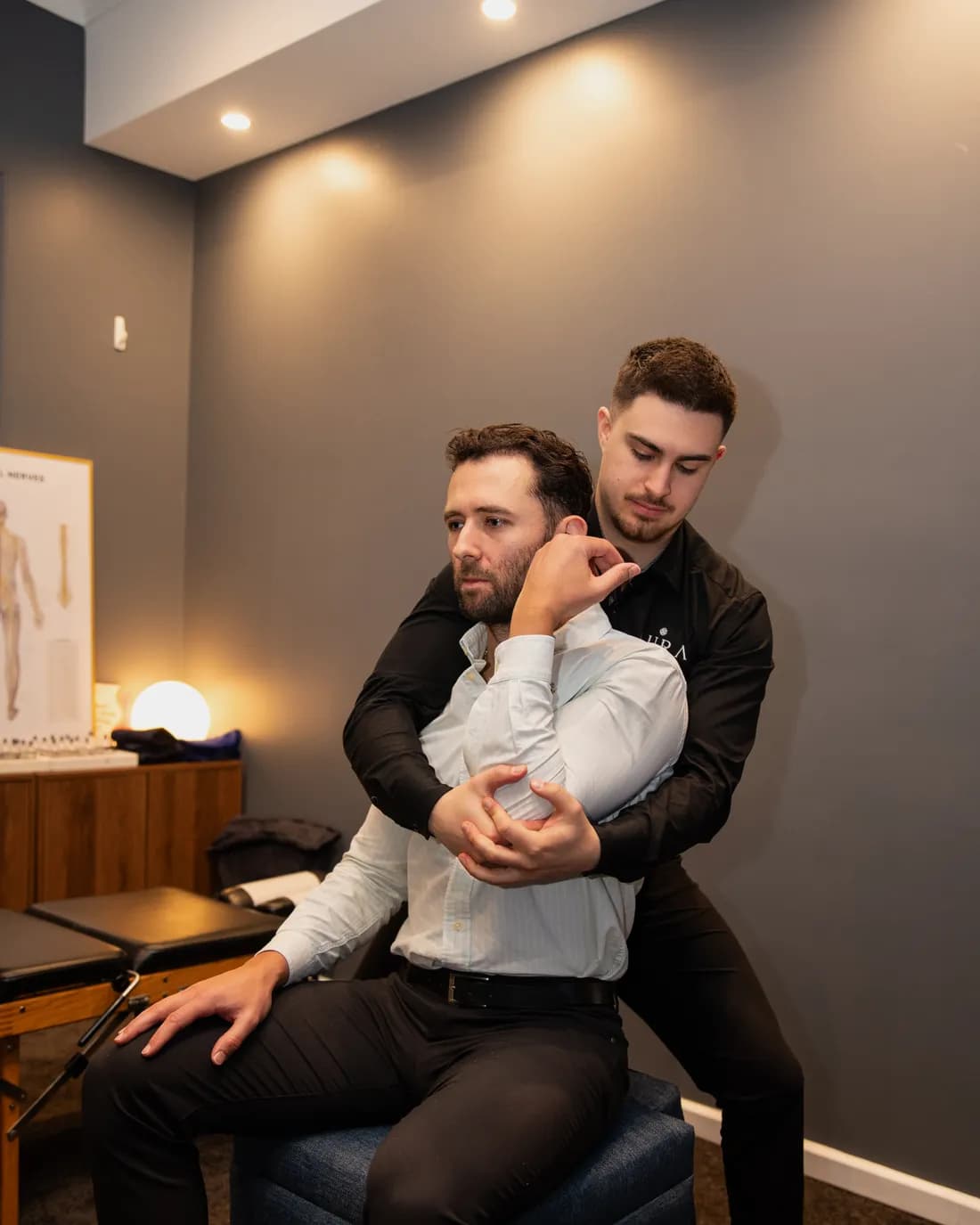
Stage three: Nervous system first chiropractic care
Specific, gentle adjustments directed at what the scans and examination found, re-measured against your own baseline so you can see what has shifted.
Your first visit
What the $99 assessment includes
$99, ordinarily $189. New patients only, one per person, no obligation to continue.
- Full case history
- Spinal examination
- Posture analysis
- Neurological examination
- Heart rate variability (HRV) measurement
- Thermographic (skin-temperature) scans
- Referral for spinal imaging (X-ray) if clinically indicated
Any imaging is charged by the imaging provider, not by Aura, and is not included in the $99.
Care is adapted in position, technique and force for a pregnant body, and it follows a full history and examination rather than starting from an assumption. Positioning changes as the pregnancy progresses, and the force used is lighter and more specific through a pelvis whose ligaments have already softened.
Care can continue through the pregnancy, with positioning adapted as it progresses. What changes is how you are supported on the table and how care is delivered, not whether it is available late on.
We do not make claims about labour, delivery or the position of the baby, because that is not something we can honestly promise. What care aims at is your comfort, movement and function through the pregnancy itself.
No referral is needed to be seen here. Telling us who is providing your maternity care is useful, and if anything we find needs to go back to them, we will tell you clearly.
The first visit is $99, ordinarily $189. It is for new patients only, one per person, as a one-off payment, with no obligation to continue. Any imaging is charged by the imaging provider and is not included in the $99.
No. Chiropractic is a primary contact profession in Australia, so you can book directly, with no referral needed.
Observations attributed to Dr Arthur Kaganovitch (Chiropractor) reflect his clinical experience at Aura and are not claims of guaranteed outcomes. This page is general information, not a diagnosis or individual advice.
Related
Keep reading

Parents
Lower back pain

Hip pain

Sciatica
Understanding lower back pain, and what actually helps it settle
From the journal
Lower back pain is the most disabling condition of working age, yet the vast majority of it is not what people fear. A researched, plainly written look at how common it really is, what tends to cause it, the part your nervous system plays, what the evidence says helps, and the myths worth retiring.
The physiological sigh: one breath pattern the evidence supports
From the journal
Two short breaths in through the nose, one long breath out. What the physiological sigh does to the nervous system, what the research actually found, and how to use it without overselling it.
Written by Dr Arthur Kaganovitch (Chiropractor). Last reviewed 8 September 2026.

Your body has been stuck in protection long enough
One visit to measure it. $99, ordinarily $189, no obligation to continue.